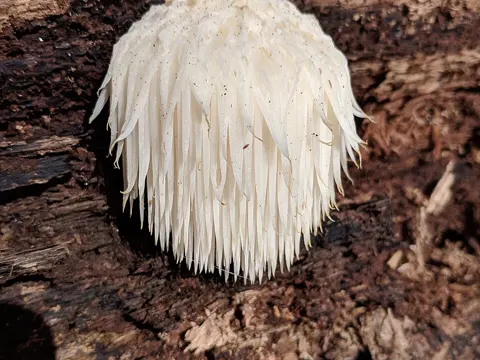
Lion's mane is one of the common names of Hericium erinaceus, which the Woodland Trust also lists as bearded tooth, tree hedgehog fungus and pom-pom mushroom. The German Mycological Society (DGfM) calls it Igelstachelbart or Pom-Pom blanc. It forms a single clump of soft, dangling spines, typically on the wounds of living or very recently cut hardwoods. Forage gives a typical window of September to November in the northern hemisphere. In England and Wales, intentionally picking a wild plant listed in Schedule 8 of the Wildlife and Countryside Act 1981 is an offence, and Schedule 8 lists Hericium erinaceum. This guide is about the wild mushroom: how to recognise it, where and when it grows, its close relatives and the rules on picking. It does not cover supplements or health claims.
MushroomExpert describes lion's mane as the only Hericium species that forms a single clump of dangling spines, rather than hanging its spines from a branched structure. It gives a fruiting body of 8 to 24 cm across, with soft spines 1 to 4 cm long hanging from a tough, hidden base that is attached to the tree.
First Nature describes an often roundish fruitbody whose spines all emerge from the same point and cascade down like a mop head. It can be up to 30 cm across, although 15 to 20 cm is more typical. The spines have pointed tips and are 1 to 5 cm long, and the fruitbody is attached by a very short, broad stipe.
The spines are white and discolour brownish to yellowish with age. The flesh is white, soft and spongy, and it does not change when sliced. The Woodland Trust describes a delicate musky smell when young that becomes strong and unpleasant as it ages.
MushroomExpert warns that positive identification is more difficult in practice. Immature specimens of the branched Hericium species often begin more or less as a single clump, and young lion's mane can have short spines of 1 cm or less. It advises making sure your specimen is mature, with signs of brownish or yellowish discoloration, before relying on the identification.
MushroomExpert says lion's mane fruits from the wounds of living hardwoods, especially oaks, usually growing alone or in pairs. It is widespread in Europe, widely distributed in North America from Canada to Mexico, and also found in Central America and Asia. Preliminary DNA analysis supports the possibility that several species are involved under the one name, some perhaps partly separated by geography.
In Britain, First Nature finds it nearly always on beech and oak trees, stumps and fallen logs, but sometimes on other hardwoods. The fruitbodies appear on damaged or felled trees, usually in old, mainly deciduous woodland. Bearded tooth is also reported to fruit occasionally on piles of sawdust. The fruitbodies are annual, but they can recur in the same place on a tree for several years.
The Woodland Trust names beech, oak and birch. It says the fungus grows on the deadwood of fallen trees and on the trunks and large branches of standing trees, especially old, veteran or ancient ones. In the UK it is mostly found in beech woods in southern England, with its population stronghold in the New Forest, Hampshire.
First Nature calls it a very rare sight in Britain, found mainly in southern England and eastern Wales. It describes the species as particularly widespread and abundant in central and southern France.
Forage gives a typical window of September to November in the northern hemisphere, with the peak in the same months, and says your own timing depends on local weather.
First Nature gives July to November in Britain and Ireland. The Woodland Trust gives a fruiting season of late August to December. MushroomExpert gives late summer and fall, or over winter and spring in warmer climates.
Hericium americanum is, according to MushroomExpert, North America's only Hericium species that combines long spines with a branched fruiting body, and it is apparently found only east of the Great Plains. Young specimens whose branches have not fully developed might be confused with lion's mane.
Hericium coralloides is recognised by its short spines, mostly about 1 cm long, which hang in rows along delicate branches. It fruits from dead hardwood logs and stumps. First Nature calls it very rare in the UK, with a rubbery, coral like branching fruitbody that is usually associated with beech and ash trees.
In western North America, Hericium abietis grows on the wood of conifers from northern California to Alaska. Young specimens that are scarcely branched might be confused with lion's mane, but lion's mane grows on the wood of hardwoods and has longer teeth.
In the UK, the Woodland Trust also names Hericium cirrhatum, which has tiered layers of white brackets with short, white spines hanging from the underside.
Hydnum repandum and Hydnum rufescens also have downward projecting spines, but First Nature notes that they are attached to a smooth topped cap.
MushroomExpert states that its site contains no information about the edibility or toxicity of mushrooms. Poison Control says never to pick and eat wild mushrooms unless they have been identified by an expert. The DGfM advises against relying on self-appointed mushroom experts or apps, and recommends a certified mushroom expert instead.
In England and Wales, section 13 of the Wildlife and Countryside Act 1981 makes it an offence to intentionally pick, uproot or destroy any wild plant included in Schedule 8. Schedule 8 lists Hericium erinaceum. Selling such a plant, or anything derived from it, is also an offence under the same section.
In Germany, Hericium does not appear among the fungi in Annex 1 of the Federal Species Protection Ordinance. The Federal Nature Conservation Act lets anyone carefully take wild mushrooms in small quantities for personal use, at places that are not subject to an access ban. Nature reserves and state rules are not covered here.
In the Austrian state of Carinthia, the mushroom ordinance lists all species of the genera Hericium and Creolophus (Stachelbärte) as fully protected all year. Fully protected mushrooms there may not be dug up, removed from their site, damaged or traded.
Rules elsewhere are not covered here, so check the law where you are before picking. First Nature argues that there is no justification for raiding the wild nowadays, because the species can be grown in cultivation. The Woodland Trust names collectors who pick the fruiting bodies for medicinal or culinary use as a threat, and calls it a species of conservation concern across its European range.
First Nature describes growing it on logs: birch plugs carrying the white mycelium are inserted into holes in cut logs and sealed with wax, and in due course white spines emerge.
The DGfM, the German Mycological Society, shows Igelstachelbart (Hericium erinaceus) in its gallery of cultivated mushrooms sold in shops. It notes that cultivated species can also trigger allergies or individual intolerances, and advises caution whenever a new species goes on the menu, even one bought in a shop.
In its general advice on picking mushrooms, the DGfM advises against eating raw mushrooms and says to heat mushrooms for at least 15 minutes at 70 degrees.
The DGfM says to take people with severe symptoms to hospital and call 112 if needed, and to contact a poison centre in the case of mild symptoms or worry. Everyone who shared the meal must be informed. Keep cleaning scraps, leftovers or vomit for the doctors if possible.
The BVL lists poison centres in Germany and Austria, for example Giftnotruf Berlin on 030 192 40 and the Austrian centre on +43 140 643 43. Tox Info Suisse runs the Swiss number 145. In the UK, the NHS says to call 999 or go to A&E if you think someone may have swallowed something harmful, and to call 111 if you are not sure. In the US, Poison Control says to call a poison center right away at 1 800 222 1222.
To find a certified mushroom expert in Germany, use the DGfM directory.
For the method behind identifying mushrooms, read the guide to identifying mushrooms. To see which species are in season near you, use the Season Finder. Both are linked below.
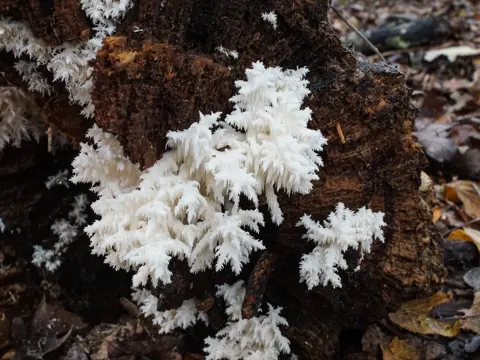
Short spines, mostly about 1 cm long, hanging in rows along delicate branches.
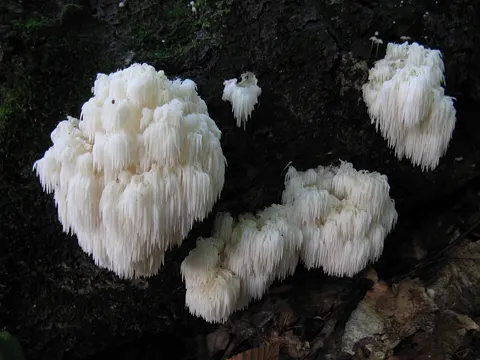
Long spines on a branched fruiting body; young specimens with undeveloped branches might be confused with lion's mane.

Downward projecting spines too, but attached to a smooth topped cap.
Photos are for orientation only: a photo alone is not enough to identify a species.
In England and Wales, intentionally picking a wild plant listed in Schedule 8 is an offence, and Schedule 8 lists Hericium erinaceum. In Carinthia, all Hericium species are fully protected. Poison Control says never to pick and eat wild mushrooms unless an expert has identified them. If someone feels unwell after a mushroom meal, the DGfM advises calling 112 for severe symptoms and contacting a poison centre for mild symptoms or worry.
Lion's mane is a common name of Hericium erinaceus, also called bearded tooth, tree hedgehog fungus and pom-pom mushroom. MushroomExpert describes it as the only Hericium that forms a single clump of dangling spines.
MushroomExpert says it fruits from the wounds of living hardwoods, especially oaks. In Britain, First Nature finds it nearly always on beech and oak trees, stumps and fallen logs.
Forage gives a typical window of September to November in the northern hemisphere. First Nature gives July to November in Britain and Ireland, the Woodland Trust late August to December.
In England and Wales, intentionally picking a wild plant listed in Schedule 8 is an offence, and Schedule 8 lists Hericium erinaceum. In Carinthia, Austria, all Hericium species are fully protected. In Germany, Hericium is not among the fungi in Annex 1 of the Federal Species Protection Ordinance. The Federal Nature Conservation Act lets anyone carefully take wild mushrooms in small quantities for personal use at places without an access ban.
Young lion's mane can have short spines of 1 cm or less, and young branched Hericium species can start as a single clump. MushroomExpert advises making sure a specimen is mature, with brownish or yellowish discoloration, before relying on the identification.
Young Hericium americanum with undeveloped branches might be confused with it, and so might scarcely branched young Hericium abietis in western North America. Poison Control says never to pick and eat wild mushrooms unless an expert has identified them, and the DGfM advises against relying on apps.
Forage shows you the species in your region and pings you when the season starts.


All information without guarantee. This text is orientation on season and habitat, not an identification guide, and it makes no claim about whether any specific plant or mushroom is edible. Many species have toxic, some deadly, lookalikes. Never eat or use anything that has not been identified with certainty by an expert, such as a qualified mushroom inspector. We accept no liability for any harm arising from the use of this information. If you suspect poisoning, call your local poison control center or emergency services right away. Mind conservation law and property rights.